A forecast may sound like something for the finance department. In a small business, though, it is mainly protection against an unpleasant surprise. A profit on paper does not mean there will be money in the account when wages, advertising or suppliers need to be paid.
I prepared the original spreadsheet in 2014. I do not consider it a financial system or accounting advice. It is a simple tool that makes me look several weeks ahead and say in time: here we can breathe, here we need to slow down, and here we need to verify whether the promised payment will really arrive.
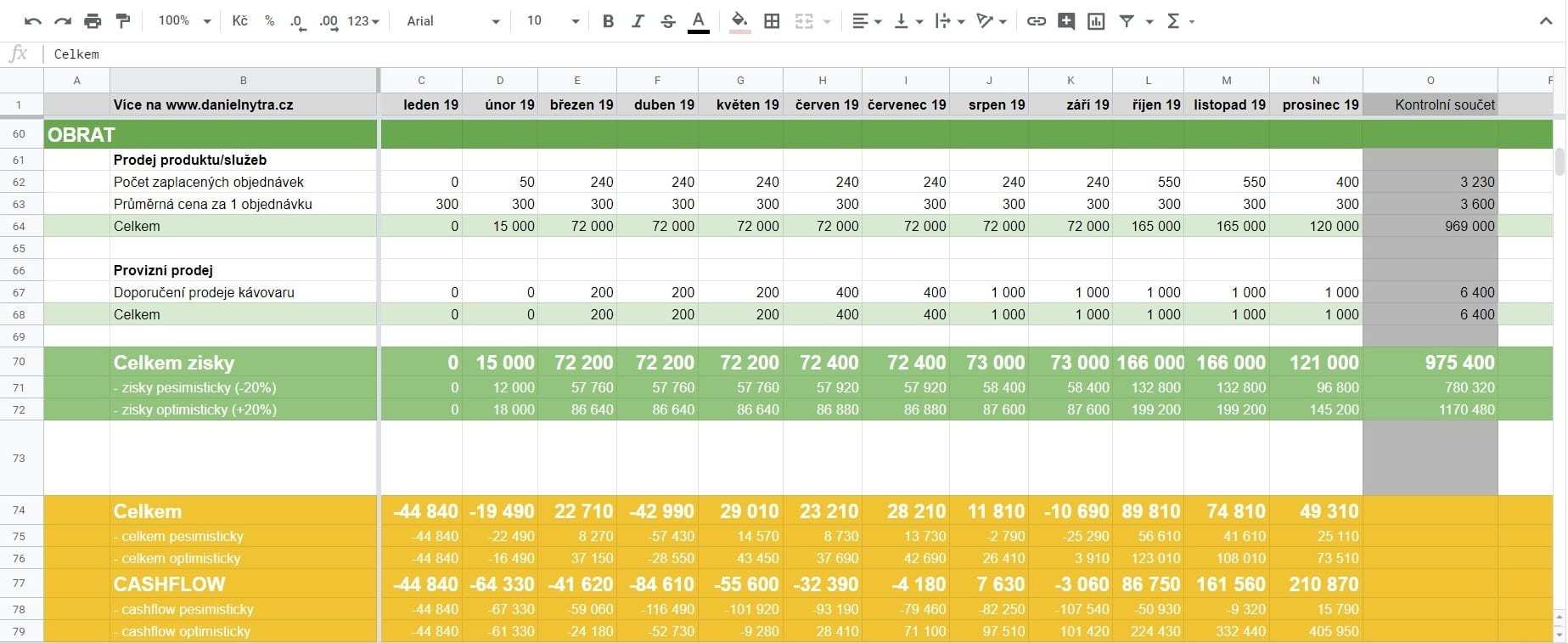
Cash flow is not the same as profit
An invoice issued today may be due in thirty days and paid even later. But an advertising cost or payroll leaves immediately. I therefore build the forecast not around when income or an expense arose in the accounts, but around the estimated movement of money in the bank account.
The basics are the opening balance, expected income, certain expenses and the resulting balance for each week. For a small business, a month is often too coarse. A weekly view shows that the problem will not arise “in October”, but between payroll leaving and two large payments arriving.
What I enter in the spreadsheet
- Certain income: amounts with a realistic payment date, not automatically the due date.
- Likely income: kept separate from certain money. A proposal is not an order, and an order is not yet a payment.
- Fixed expenses: wages, contributions, rent, software, leases and other obligations.
- Variable expenses: advertising, suppliers, production or performance-based commissions.
- One-off events: tax, equipment replacement, refunds, insurance or a larger investment.
- Reserve: an amount I do not want to go below, even in the optimistic scenario.
I separate the figures by their degree of certainty. If I enter every sales opportunity as future income, I am not creating a forecast. I am creating a reassuring story.
Three scenarios are more useful than an accurate prediction
I most often work with a base, cautious and better scenario. In the cautious one, I move uncertain payments later, reduce expected business and keep expenses at their actual dates. I do not use the better scenario as a plan, but as information about what can be done in addition if the assumptions are confirmed.
The point is not to predict the balance down to the crown. The point is to see decision points. If the cautious scenario drops below the reserve in six weeks, I still have time to change payment terms, speed up invoicing, postpone an investment or adjust the pace of campaigns. Once I only look at the bank account, some of the options no longer exist.
How I connect the forecast with marketing
A marketing budget should not be a number written into a spreadsheet once a year and then spent without context. I need to know when the expense pays back, how long the sales cycle is and how much cash growth temporarily consumes.
A rapidly growing campaign can put a company in trouble if advertising is paid today, suppliers next week and the customer only in two months. That is why, alongside return on investment, I also track the time it takes for money to return. For deciding priorities, my online marketing checklist and a broader look at small-business marketing are also useful.
A simple weekly rhythm
- I update the actual balance and remove items that have already occurred.
- For unpaid invoices, I verify the realistic date, not just the due date.
- I add new obligations and one-off expenses.
- I compare the previous estimate with reality and correct recurring optimism.
- I record the decision: what we will do, who will do it and at what threshold we will change the plan.
The spreadsheet is not the goal. It should shorten the time between a signal and a decision. If no one opens it regularly or no action follows from it, it is just another file.
What to watch out for
- Do not mistake revenue for cash.
- Do not add likely contracts together with confirmed payments.
- Do not forget VAT, tax, contributions and seasonal expenses.
- Do not overwrite a past estimate without checking the difference against reality.
- Do not present a simple operating forecast as accounting or as a financial model for an investor.
When marketing, sales and finance are looking at different figures, another dashboard will not help. First, they need to form one shared understanding of when money will arrive and what the business can afford. If you need to align a marketing plan with real economics, describe your situation to me via contact.