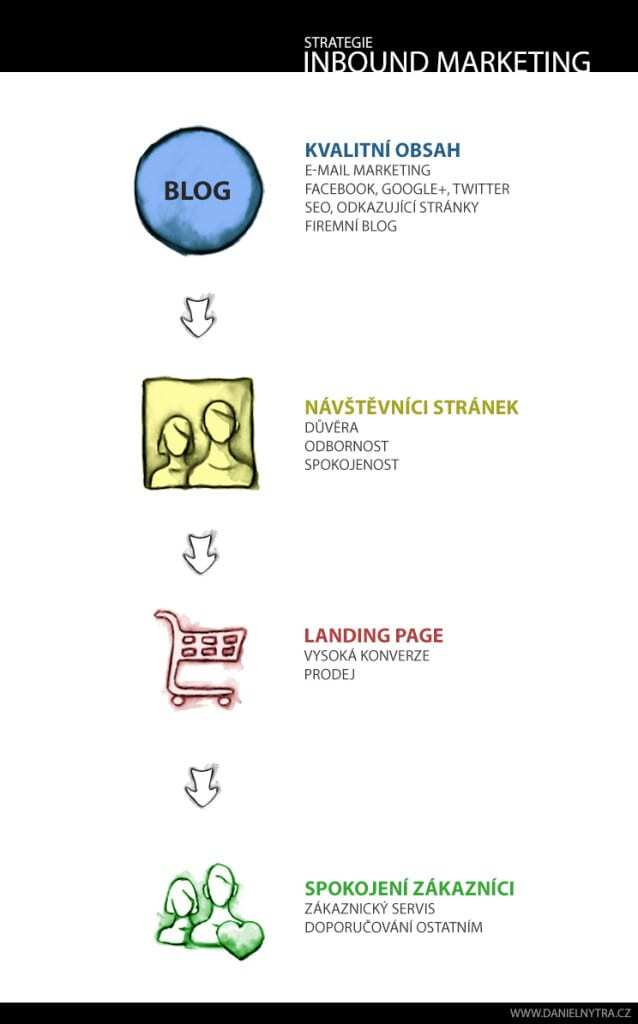
I created the original infographic in 2014 as a shortcut to a longer article about inbound marketing. It followed a neat direction: create content, bring in a visitor, send them to a landing page, gain a customer and measure everything.
As a foundation, the map is still useful. But today it needs one important correction: people do not move around the internet in a tidy sequence. They read an article on mobile, encounter the brand again in search, ask a colleague, open an email and come directly three weeks later. Marketing likes to turn this into a funnel. The customer is doing their own thing in the meantime.
Start with the customer’s decision, not the content format
The first question is not whether to make a video or write an article. The first question is: what should the right person clarify after encountering the content?
- Do they first need to name the problem?
- Are they comparing several paths?
- Do they need proof that the solution works in their situation?
- Do they need to defend the decision to other people in the company?
Only the answer gives rise to the topic, format and distribution channel. Content disconnected from a decision can have decent traffic and zero business meaning. A nice chart. Weak marketing.
The current map has six connected parts
- Problem and audience. Choose a situation the company can solve and wants to own commercially.
- Useful content. Give people an experience, argument or tool that moves their decision forward.
- Distribution. Do not assume publishing is distribution. Connect search, email, social media, partners and salespeople’s work according to where customers actually spend time.
- Next step. Offer a natural continuation: a related analysis, subscription to a specific topic, work sample or conversation. One CTA does not need to be crammed everywhere; it needs to be in the right context.
- Sales and care. Passing on a contact is not the end of marketing. Content can help during the proposal, service implementation and further cooperation too.
- Measurement and decisions. For each part, decide in advance what you will reinforce, change or switch off based on the result.
Traffic is a signal, not a goal
For initial orientation, I watch whether relevant people find the content, reach the important part and continue to the next step. To manage the company, I also care about lead quality, decision length, content’s help in sales and the topics that bring the right customers.
A single visit can also be recorded across several devices and channels. I therefore do not pretend to precision the data does not have. UTM parameters help keep campaign labelling orderly; the practical process is in How to set UTM parameters correctly. You can find the decision framework for analytics in the Google Analytics 4 guide.
When inbound marketing slows you down
Content will not help a product customers do not want, or a sales team that cannot process an enquiry. It will not solve a poor margin or replace paid distribution where the company needs a result quickly. Inbound is a long-term asset. That sounds good, but it also means long-term capacity.
If a company cannot choose several topics, assign responsibility for them and decide based on results at least quarterly, it is better to start with a smaller pilot. Three honest pieces of content with clear use are better than an editorial calendar full of filler.
A good inbound marketing map does not show how much content to produce. It shows how content helps customers decide and the company earn.
I discuss the strategy in more detail in Inbound marketing is not marketing without money. For the wider system, the marketing mix and communications mix are also useful.