A company publishes dozens of articles, yet makes slow progress in Google and is barely visible in AI answers. The first reaction is often: we need a new format, special markup, or a GEO tool. In most audits, however, I find a more ordinary problem. The website offers no reason why it, specifically, should be a source.
Google now says fairly clearly that AI Overviews and AI Mode have no special technical requirements or secret AI markup. Search fundamentals still apply: a page must be accessible, indexable and useful. And its content must contain something that a hundred generic rewrites do not.
A source is not created by one sentence or one article
An AI answer may use several searches and several sources. Visibility is therefore not a simple competition for one exact phrase. That does not mean we should stop addressing topics, user intent or technical SEO. It means that a page must succeed as part of a trustworthy website.
For me, it is useful to divide the work into four layers:
- Availability: the search engine can find and read the page, and understands its canonical address.
- Clarity: headings, text, images and links clearly state which question the page answers.
- Evidence: claims have a source, method, example or experience that can be assessed.
- Reputation: both author and website have traceable context, related content and mentions that were not created by buying anonymous links.
The greatest advantage is content that cannot be cheaply replaced
Almost anyone can now create generic definitions. I see competitive advantage in material created through real work: why we chose a particular process, what failed, what the data limitations were, how we made decisions, and what would not apply in another company.
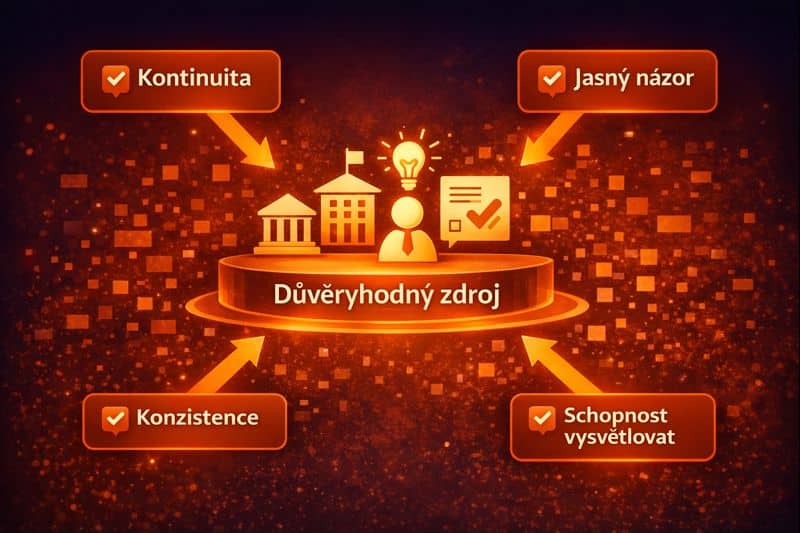
You do not have to publish trade secrets or a client name. You can describe the starting point, decision criteria, an anonymised process and the limits of the result. If numbers cannot be published, say so. Precision is more authoritative than an impressive percentage without context.
What a good page should contain
One clear question and a quick answer
Users should not have to extract the point from a long introduction. The first part should confirm that they are in the right place and show the conclusion. Detail, exceptions and evidence can follow.
Specific experience or original supporting material
Work with your own process, data, photographs, a chart, calculation, expert interview or precisely described test. When using a technical claim, link to primary documentation where possible. A third-party summary is not evidence merely because it looks professional.
Limits of applicability
Good advice also says when not to use it. A process for an e-commerce shop may not apply to industrial B2B. A test with thousands of conversions cannot simply be transferred to a company receiving three enquiries a month. These conditions help readers and systems understand the meaning of a claim.
A visible author and accountability
For important topics, I want to know who wrote the text, from which position they speak and when it was updated. An author page need not be an autobiography. Relevant practice, a connection to other work and a way to make contact are enough.
Internal links to the next decision
One page rarely covers an entire topic. A link should move the reader to the next step, rather than mechanically repeating a keyword. A new website can continue with a basic SEO process, explain technical terms in the technical SEO glossary, and offer a relevant case study or contact on a commercial page.
Technical minimums have not disappeared with AI search
According to Google's official guide to AI features in Search, it remains important that Google can crawl, index and display a preview of the page. Good internal linking, text-accessible content, high-quality images and structured data matching what people actually see are equally helpful.
Conversely, there is no need to rewrite a website into fragments for a model, create special AI schema, or chase a minimum word count. LLMs.txt can be a voluntary directory for some agents, but Google ignores it for Search and it does not guarantee citations.
How I would build a content system in a company
- I start with commercial questions. I list what a customer needs to know before enquiring, where they hesitate and what they need to compare.
- I divide topics by intent. Explaining a problem, comparing solutions and a service page each have a different role.
- I assign internal sources. Who has the experience, data, photographs, customer objections or methodology?
- I create core pages and supporting content. Every article receives a clear role and links to related decisions.
- I introduce editorial review. Fact checking, author, update date, working links and a check that the text still matches the offer.
- I measure impact, not publication count. I follow queries, landing pages, visitor quality and subsequent commercial steps.
What to measure today
Search Console shows queries, pages, indexing and technical problems. Google is gradually adding reporting for generative AI features too, although availability may vary by account and market. I would not wait for one perfect metric. What matters is the combination of visibility, relevant visits and conversions.
For visits from AI tools, create your own source group in analytics and follow it over time. A small absolute number does not yet mean failure: in B2B, one qualified visit can be more valuable than a hundred readers with no connection to the offer. At the same time, do not label every change an effect of AI; without comparison and a sufficient period, it is only an assumption.
Authority is not a writing style, but a demonstrable position
Authoritative text is not the text with the greatest number of confident sentences. It is text where readers can see how the conclusion was reached, who stands behind it and where its limits lie. This is precisely the kind of content that makes sense to people, traditional search and AI answers.
If you want to find where your website loses credibility or the connection between content and services, write to me through contact. We will not start with the number of articles. We will start with the customer decision that the website should make easier.